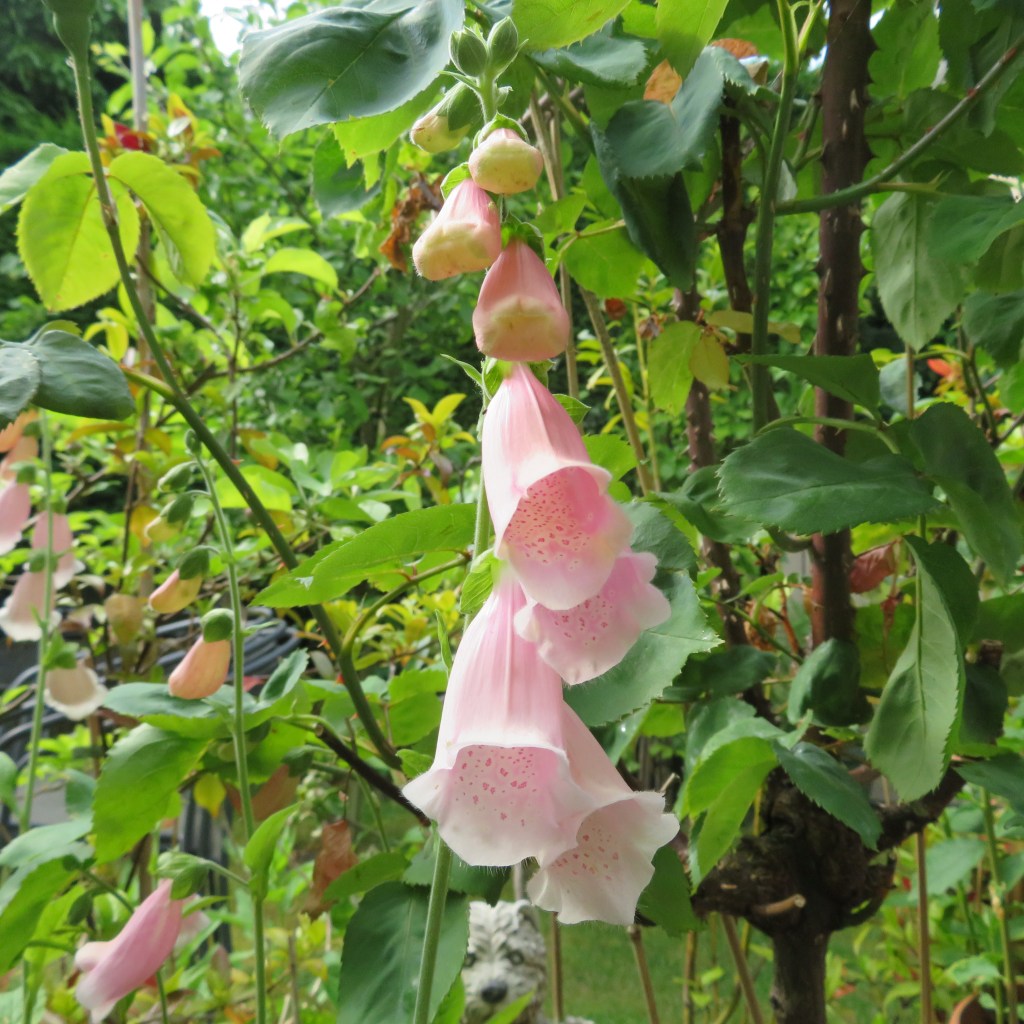
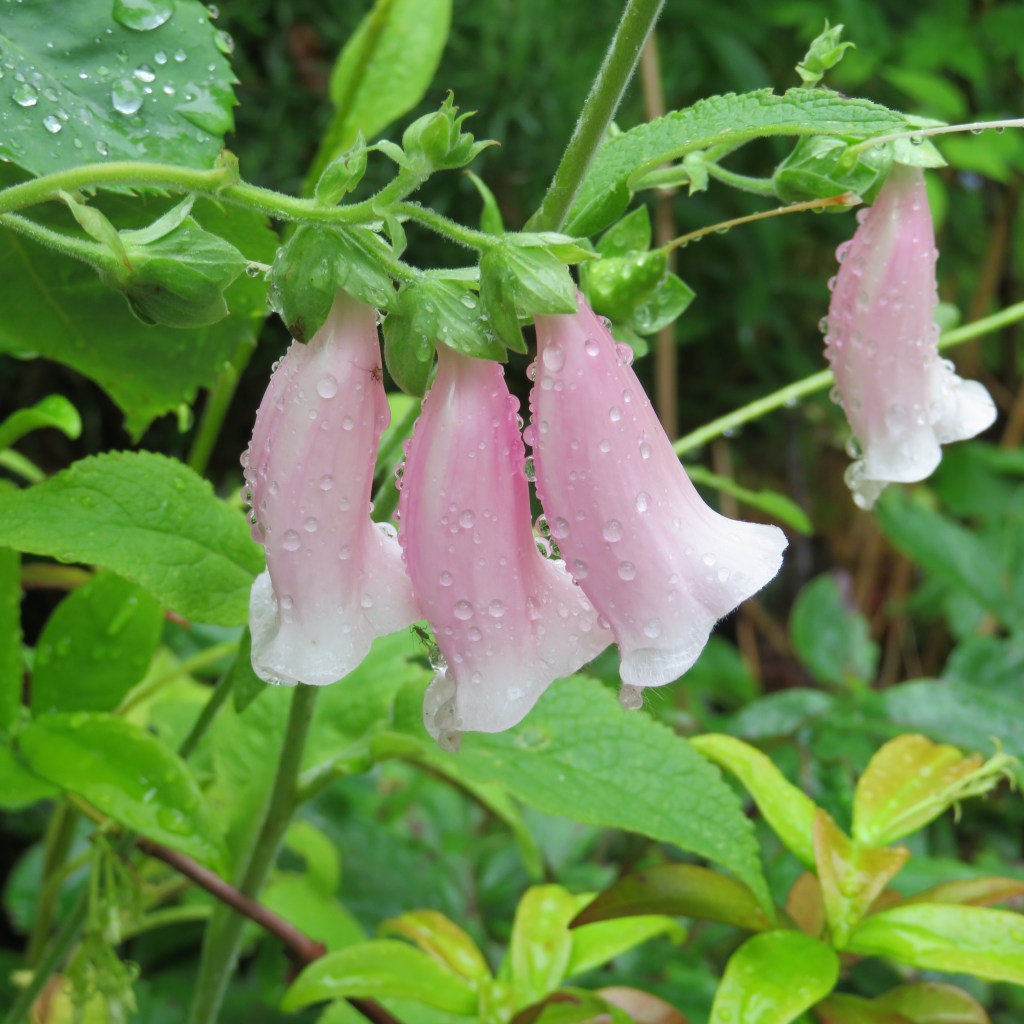
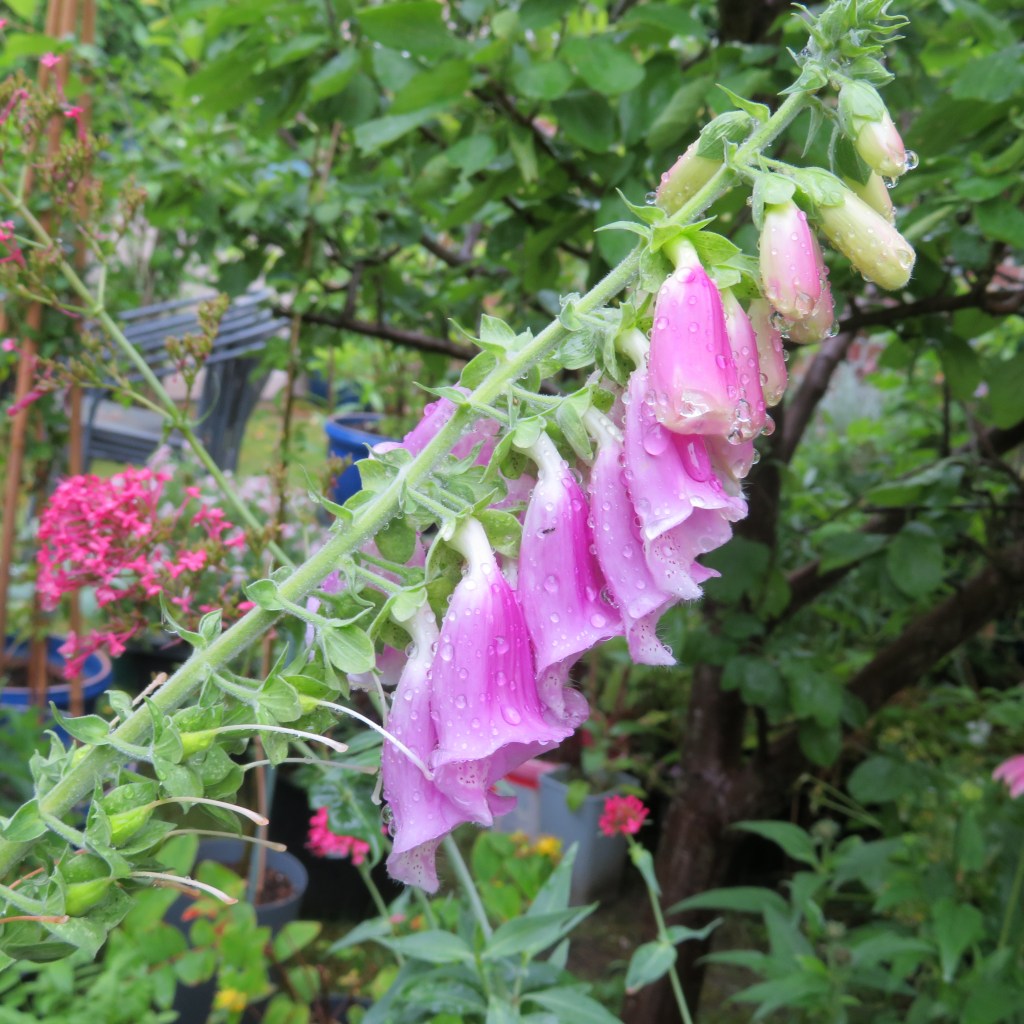
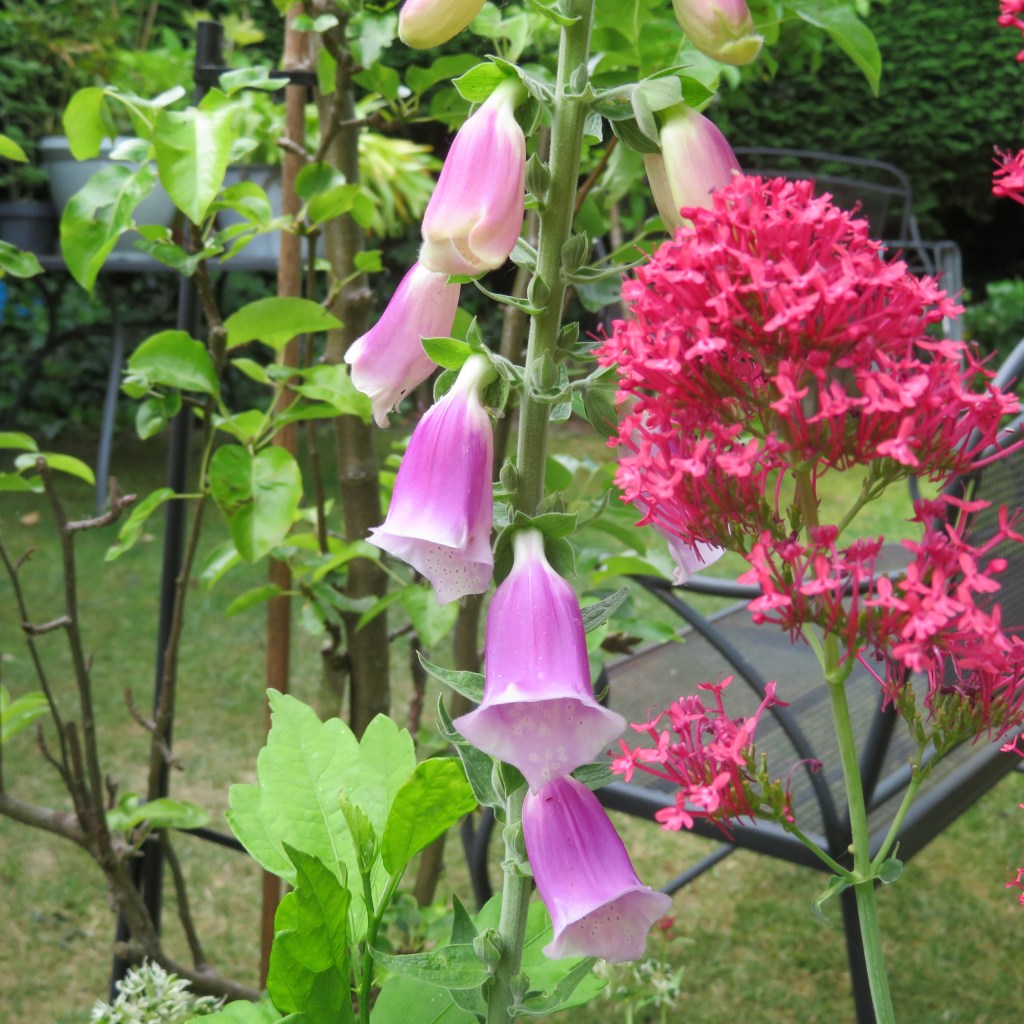
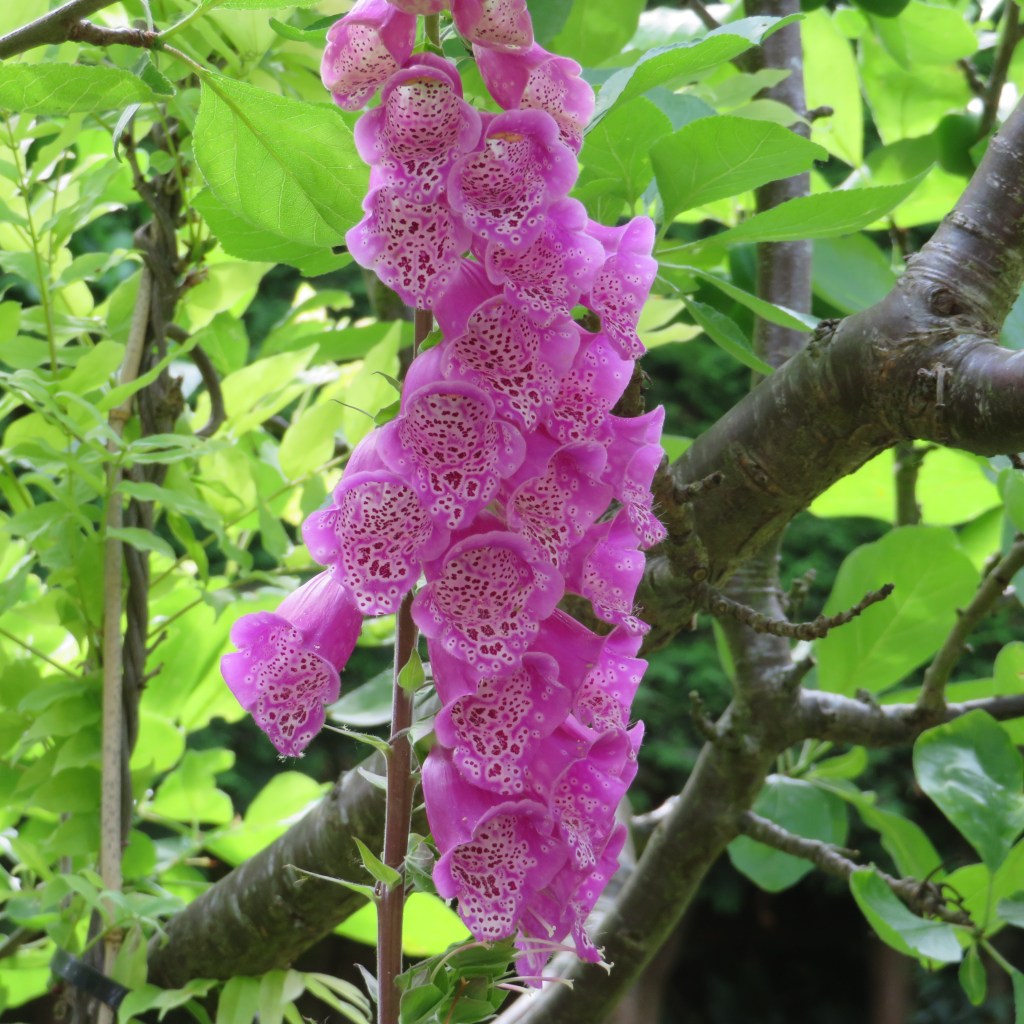
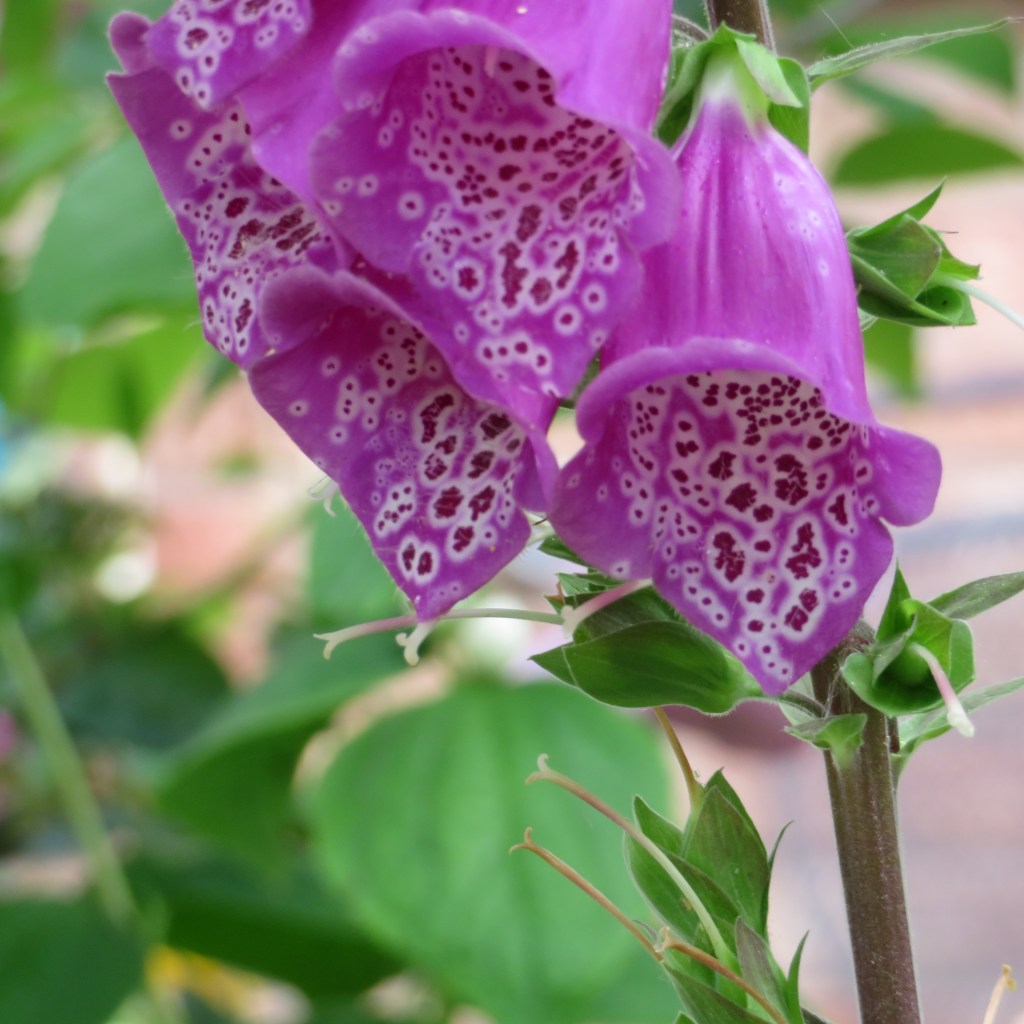
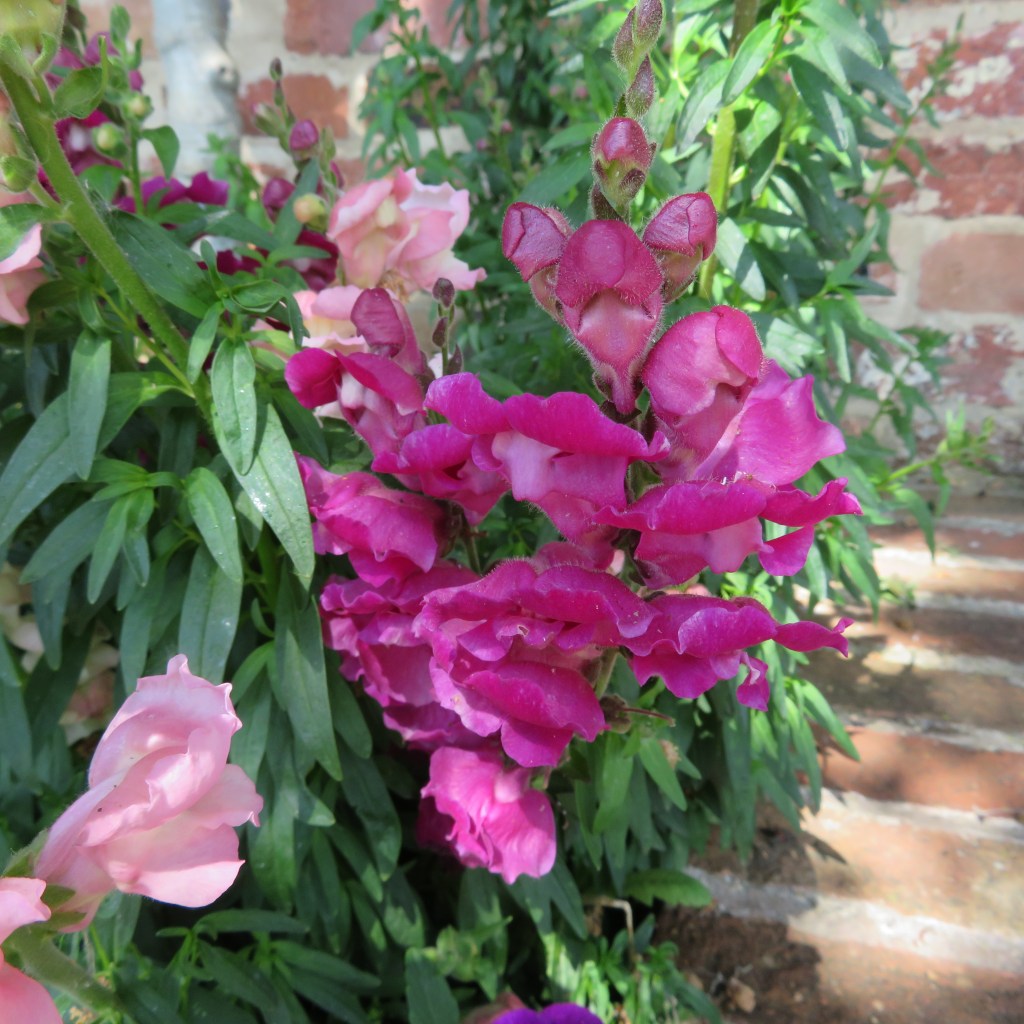
Photo Credits: All ALWP CEBP showing varieties of foxgloves and snapdragons
#MedicineTrees #MedicinalHerbs #CardiacGlycosides #Digoxin #Digitalis #Digitoxin #MedicineTrees #Botanical#MedicinalPlants#HerbalMedicine #PlantMedicine #TakingLeadFromNature #Herbals #PlantHybridisation #GregorMendel #PisumSativum #MendelianLaws #HeredityLaws #SnapdragonsAndFoxgloves #ContemporariesDarwinMendel #MendelianLaws #FoxglovesColour #DigitalePouprée #Dedalera #Digitale #毛地黄 #DigitalisPurpureaColour @MedicineTrees2023 #SkinColour #UniversityOfReading
Two years ago, I was given a white and a purple foxglove which delighted me all summer. As biennials, both plants died after flowering. Luckily, foxgloves self-seed profusely and randomly, and this year I had second-year plants with an array of colours ranging from purple to pink, and one with two distinct colours in the same flower (see photos), but none of the pure white. Some are as tall as the original plants, but most are smaller when they flowered. That’s natural hybridisation in action, the results often modified by the soil where the seeds fell at the whim of the autumnal breeze.
To my surprise, I recently found that the genetics for such colour variations in the foxglove had already been worked out over a century ago by botanists from Reading University College, an extension college of the University of Oxford and now part of the University of Reading.
Amazingly, the work was completed in 1910, just four years after William Bateson of Cambridge University coined the term ‘Genetics’ to describe ‘the science of heredity and variation’. The first chair in the subject was endowed that year. In addition to the colour of the flowers, the Reading botanists were interested in the symmetry of the flowers (peloria). In their report, they explained that they wanted to test whether these traits followed Mendelian Laws.
‘The mode of inheritance of peloria has a special interest owing to the fact that Darwin (1868), working with the snapdragon (Antirhinum), obtained statistics which, as Bateson (1901) has pointed out, indicate for this phenomenon a simple Mendelian mode of inheritance’, they explained.
They concluded that the foxglove traits they studied followed Mendelian Laws and therefore that the frequencies of the alternative presentations for each of those traits were predictable.
If you are interested in further details, please see the original reference [Keeble F, Pellew C, Jones WN. The inheritance of peloria and flower colour in foxgloves (Digitalis purpurea) New Phytologist 1910;9:66-77.] The report, one of the earliest on the validity of Mendel’s Laws, is used as an illustrative example in many textbooks on genetic analysis (e.g., Griffiths et al.), though often without referencing it.
Who was Mendel?
Gregor Mendel (1822 – 1884) was an Augustinian friar who eventually became the abbot of St Thomas’ Abbey in Brünn (Brno) in the Silesian part of the Austrian Empire, then in its heyday, and now part of the Czech Republic. Fascinated by the mystery of inheritance, Mendel wanted to know whether there were universal laws that governed how specific traits were transmitted down generations. Through his studies he discovered what are now known as the Mendelian Laws of Inheritance.
In deriving his laws, Mendel studied, among many others, how seven traits (seed shape, albumen colouration, colour of seed coat, coloration of unripe pods, position of flowers, and length of stem) of the pea (Pisum sativum) were transmitted.
He first presented his momentous results at two evening meetings of the Natural History Society of Brno (see below) held on 8 February and 8 March 1865.
In concluding his lecture, Mendel, the scientist, stated that ‘the validity of the laws proposed for Psium (peas) needs confirmation and a repetition of at least the more important experiments is therefore desirable’.
Although Mendel had also shown that the laws also applied to beans (Phaseolus), he asked whether ‘variable hybrids of other plant species show complete agreement in behaviour.’ That question, he said, ‘remains to be decided experimentally’ but he was confident that since ‘unity in the plan of development of organic life is beyond doubt, … no basic difference could exist in important matters.’
Mendel, soon after found that laws hd to account for complications. In follow-up experiments with Hieracium (hawkweed), Mendel was unable to validate his Laws but Darwin working on hybridisation of snapdragons (plant of the same family (Plantaginaceae) as the foxglove) reported the same numerical results but failed to draw the momentous inferences. Darwin forte was in drawing over-arching qualitative inferences (e.g., the origin of species) rather than in numerical interpretation. For this, he sought the help of his first cousin, the famous statistician Francis Galton, infamous for his promotion of eugenics.
Mendel’s work was ignored for several decades, probably because those in the lecture room, and early readers of the subsequently printed version, did not recognise the wider implications of his Laws. Although frustrated, Mendel felt convinced that one day the world would recognise the importance of his work.
Mendel’s time did come but it arrived too late for him on this mortal earth. He had been dead for sixteen years when his Laws were rediscovered.
Independent validation, the gold standard in science, came in 1900 with publication of three papers by researchers in different countries – the Dutch, Hugo De Vries, the German, Carl Correns, and the Austrian, Erich von Tschermak-Seysenegg.
Mendel’s Laws of Inheritance laid down the foundation of modern genetics with its universal applicability in the living world – plant and animal. Knowing the Mendelian Laws enable us to understand complex phenomena in quantitative terms, such as the proportion of women who would have an increased risk of breast cancer being passed down to them, as Angela Jolie does, forcing her to decide on preventive mastectomy. The Laws also allow us to identify specific genes to disable as therapy for cancer. Genetic counsellors use his Laws to explain the meaning of carrier status and the risk of passing on genetic diseases and abnormalities such as cystic fibrosis and colour blindness. Molecular horticulturalists, of course do their magic to delight us with new varieties of flowers and fruits (see our previous post on the Camelia).
Mendel’s choice of the humble pea (Pisum sativum) was lucky, but more importantly the result of much hard pilot screening and experimentation. This approach is still used by drug developers before undertaking their pivotal (Phase III trials). Mendel’s complete studies included some 30,000 pea plants. The traits that he chose were controlled by single genes. If he had used mice, as he originally intended but was dissuaded from by the then abbot, or indeed many other plants, his experiments would not have been as informative because most traits are controlled by many genes interacting. For example, unlike pea seed colour, which is controlled by a single gene, the colour of human skin is controlled by over 150 genes.
‘Nothing in biology makes sense except in the light of evolution’, argued the geneticist Theodosius Dobzhansky in 1973. But, neither would evolution makes sense without random genetic mutation and the natural selection that follows, as Darwin proposed. The Mendelian Laws of Inheritance tell us in mechanistic and quantitative terms how the mutations get passed on to produce traits with alternative forms in a world where the fitter has a greater chance of survival.
For those of you who may enjoy more of Mendel’s story, this is my reconstruction of Mendel’s ground-breaking lectures, based on historical documentation.
Friday 8 Feb 1865
It is cold on this Friday evening in Brno. The sky is clear and there is a full moon that Erasmus Darwin and his Lunar Men would have loved. Mendel and some of his fellow-monks make their way to the Realschule, a splendid stone edifice that still looks youthful despite its fifty-four years; a new kind of institution that aimed to provide a broader education than that provided at the Gymnasia. It is where Mendel has been teaching physics and natural science for eleven years.
Gustav von Niessel, Secretary of the Society welcomes Mendel who sets down his thick wad of lecture notes and the pea plants he has brought to serve as props.
Mendel looks up. In the room are some forty people, mostly familiar faces, fellow teachers and monks but also some supporters from further afield, including friends from his student days in Vienna: a geologist, a mineralogist and a pharmacist – Karl Theimer, chair of the meeting who introduces Mendel and his lecture – Experiments on Plant Hybrids.
‘Artificial fertilisations that were carried out on ornamental plants with the aim of producing new colour variants, provided the motivation for the experiments that shall be reviewed here’, starts Mendel.
‘The striking regularity with which the same hybrid forms always recurred whenever fertilisation happened between like species inspired further experiments, the task of which was to follow up the development of hybrids in their descendants.
‘To this task, careful observers …. have sacrificed part of their lives with untiring endurance.
That no one has succeeded so far in establishing a generally valid law for the formation and development of hybrids cannot astonish anyone who knows the extent of the task and can appreciate the difficulties with which experiments of this kind have to contend.
A definite decision can only be arrived at once detail-experiments from the most diverse plant families have been presented.
Although numerous experiments have been done, so far none have been carried out to such an extent and in such a way that it would be possible to determine the quantity of different forms under which the descendants of hybrids appear … to establish their mutual numerical proportions.
It does indeed take quite some courage to undertake such a far-reaching task; nevertheless, this appears to be the only correct way to finally arrive at the solution to a question the significance of which to the developmental history of organic forms should not be underestimated.
The present treatise reviews a specimen of such a detail-experiment.’
Mendel explains that he chose peas to study after careful pilot studies because they possess
‘constantly differing traits, their hybrids suffer no noticeable disturbance in their fertility in successive generations and their hybrids … easily protectable, from the influence of all alien pollen during the flowering period.’
The experiment he says, ‘has now been essentially completed after the passage of eight years.’
He describes the seven traits of peas which he chose to study, illustrating them as he holds them up with the pea plants and peas that he has brought with him – seed shape, albumen colouration, colour of seed coat, coloration of unripe pods, position of flowers, and length of stem.
He explains that for each of these traits there are two alternatives. For example, for seed shape, the peas are either round or irregularly angular.
The trait that passes ‘into hybrid association entirely unchanged or almost entirely unchanged, thus themselves representing the trait of the hybrid’ is ‘termed dominating.’ The trait that becomes ‘latent in the association, recessive.’
‘The word recessive was chosen because the trait so designed recedes or disappears entirely in the hybrid but reappear unchanged in the progeny.’
When two varieties are crossed, examination of his hybrids show that about three quarters of them are on one type and the other quarter of the other type. They showed a ratio approximating 3 to 1. For example, in the study of seed shape, ‘from 253 hybrids, 7324 seed were obtained in the second experimental year. Of them 5474 were round or roundish and 1850 angular wrinkled. This gives a ratio of 2.96:1’.
He explains that this peculiar ratio appeared for every trait that he studied.
It is now close to an hour that Mendel has spoken about the ‘more than 10000 plants’ that he studied. He explains that if one were to imagine crossing a monohybrid Aa with A and a representing units underlying a contrasting pair of presentations of a specific trait (shape), then one would expect the progeny to possess units spread algebraically as (Aa) x (Aa) = AA + 2Aa + aa.
Summarising, Mendel writes this down in short form as A +2Aa + a.
If A is dominant (e.g., round seed unit) then the plants carrying aA units will produce round peas. Mendel calls the unit which is dominated when both are present, recessive. Only those with the aa units (both units recessive) will produce angular peas. Therefore, overall, the plants grown in the second year will produce peas in the ratio of 3:1.
[(1 part AA (round seeds) + 2 parts Aa (round seeds)] : [1 part aa (angular seeds)]
Plant characters do not blend to produce less round and less angular seeds. They are passed on as discrete factors, Mendel explains.
Mendel looks up. The audience appears a little sleepy and lost. Mendel decides that more algebra to explain what happens when hybrids with two traits are crossed is best left to the next lecture. Friday 8th March. Same place. Same time.
Friday 8th March 1865
Mendel takes his audience further into the world of the imaginary and deeper into Pythagoras’s numerical world to explain what happens when hybrids with another trait (e.g., seed colour where B is dominant Yellow and b recessive Green) are crosses with those of seed shape.
Imagine the cell … Imagine the process of sexual reproduction … Imagine seed production …
The dihybrid cross (seed shape and seed colour) would be expected to produce units in the ratio given by
(AA + 2Aa + aa) x (BB + 2Bb + bb) or AABB + AAbb + aaBB + aabb + 2AABb + 2aaBb + 2AaBB + 2Aabb + 4AaBb.
Mendel must be assuming that the audience would be able to work out that expressed as combinations of the two visible traits,
(Round and Yellow peas), (Round and Green peas), (Angular and Green peas), (Angular and Yellow peas) (Angular and Green peas),
this would translate in the proportions 9:3:3:1.
To some in the audience working out all these proportions is a tall order. How specific alternative presentations of traits skipped generations and come back to life still no doubt puzzle them.
Mendel tries to explain by postulating what was happening during fertilisation.
‘… the hybrids produce ovules and pollen cells which in equal numbers represent all the constant forms which result from the combination of characters brought together in fertilisation.’
The determinants, ‘the formative elements’, which transfer characters (traits) from generation to generation ‘follows a constant law,’ when they meet ‘in the cell in a viable union’.
Today, Mendel’s elements are known as genes. Mendel’s 3:1 ratio is now known as Mendel’s Law of Segregation of Genes, and the 9:3:3:1 ratio as the Mendel’s Law of Independent Assortment – Genes for separate traits are passed independently of each other.
In concluding his lecture, Mendel, the scientist, states that ‘the validity of the laws proposed for Psium (peas) needs confirmation and a repetition of at least the more important experiments is therefore desirable’.
The local newspaper report that the lecture ‘was very well received’ and that Professor Niessel added to the lecture by reporting that ‘with the aid of the microscope, he had observed hybridizations in fungi, mosses and algae’, suggesting that further observations of this kind … will give further clarifications.’[i]
Although Mendel has shown that the laws also applied to beans (Phaseolus), he asks whether ‘variable hybrids of other plant species show complete agreement in behaviour.’ That question, he says, ‘remains to be decided experimentally’ but he is confident that since there is ‘unity in the plan of development of organic life is beyond doubt, … no basic difference could exist in important matters.’
Mendel had studied Darwin’ Origin of Species and of his view of the unity of life. He highlighted and annotated a copy of the book’s German translation, but the two great men never met.



 Medicine Trees
Leave a comment