‘Chance favours the prepared mind.’ Louis Pasteur
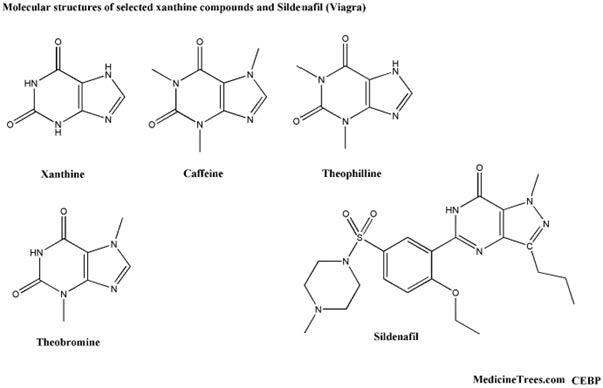
If you have a phobia of chemical structures, please bear with me. Chemical structures and their modification are often no more complex than building with Lego blocks in the hands of the initiated. I shall illustrate by recounting how one morning, scientists with no chemophobia, having a sandwich and a cup of tea in the south of England, discovered Viagra (sildenafil) by taking a lead from nature under the guidance of the Princes of Serendip.
The starting point is tea and its main active component caffeine of which we consume hundreds of tons each year in our tea, coffee, and cocoa. These drinks also contain lesser amounts of related compounds, collectively known as xanthine alkaloids, including theobromine and theophylline. All three are used therapeutically. While caffeine is now rarely prescribed on its own except for some rare diseases affecting the brochopulmonary system of premature infants, it is still popular as combination analgesic products bought over the counter. Theophylline, once among the most widely precribed drugs for chronic obstructive pulmonary disease (COPD), still accounted for more than 600 thousand prescriptions issued by English general practitioners in 2021-2.
When drug developers come across a clinically useful naturally-occuring compound, they immediately tinker with it with a view to improving its safety and/or efficacy, to find new applications, or to obtain exclusivity through new patents. This tinkering involves structural modification of the original compound by adding or removing bits to it and testing its activity, a process, analogous to Lego building, they refer to establisihng sructure-activity relationships. Cynics call it the molecular roulette approach to drug discovery but this is unkind as much of the search is targeted and informed by sophisticated drug-receptor or target modelling.. Thousands of derivatives of the xanthine alkaloids have been synthesised this way and among them was sildenafil. Figure 1 illustrates how the basic xanthine alkaloids are structurally related and how modifications lead to sildenafil.
At the time of theophylline peak popularity, drug companies were keen to look for potential best-seller modifications of the xanthines for treating hypertension which affects close to half (~116 million) of the adult population in the US alone. Another potential application was for treating angina, the pain arising from heart muscle oxygen starvation due to blockage of the coronary vasculature.
Whenever a new molecule is proposed for clinical use, drug regulators require extensive pre-cinical and clinical testing to inform on its efficacy and safeyy on the target patients but usually on healthy volunteers first to establish how the drug is absorbed, its dosing, and its initial safety. It was during the early volunteer and clinical studies of sildenafil for the treatment of angina that reports of erections in males were reported as a side-effect. Some say that a diligent nurse noticed the side-effect while monitoring male subjects in one of the trials, others that the young men wanted to hold on to the pills at the end of the studies. In any case, a large scale well-controlled study subsequently showed beyond doubt that the drug worked in men with erectile dysfunction.
Viagra (sildenafil) made history when it was licensed in the US 25 years ago as an oral therapy for male erectile dysfunction. By the end of the first year, the pills had, in the terminology of pharmaceutical marketeers become a blockbuster drug, earning Pfizer, the company we more recently associate with the COVID-19 messenger RNA vaccine, more that $1 billion. Over 3.3 million prescriptions at a cost of £ 5.7m were issued for sildenafil for erectile dysfunction in 2022/23 in England alone.
As a testimony of its efficacy, and evidence of the poor performance of alternative plant remedies for male erectile dysfunction, sildenafil is one of the commonest undeclared ingredients in herbal or health remedies, otherwise inactive, promoted as sex potency supplements. The US Food and Drug Administration often announces recalls of such supplements sureptitiously laced with sildenafil. One of the latest (6 Sept 2023) was a capsule ‘WEFUN’ sold as a supplement to ‘Maximise Your Potential’ with ‘Confidence and Energy’.
A planned Part 2 of this Post will be on why Viagra does not work in women with sexual dysfunction and what research is being done in this area to address this unmet need.
Part 3 will be a short piece on Shakespeare’s aphrodisiac
Part 4 will consider Herbal remedies for sexual dysfunction and as aphrodisiacs
Photo credits: ALWP CEBP
#MedicineTrees #Botanical #MedicinalPlants #HerbalMedicine #PlantMedicine #TakingLeadFromNature #Herbals @MedicineTrees2023 #ErectileDysfunction #Impotence #Viagra25thAnniversary #SerendipityMedicine #PrincesOfSerendip #Tea #Cocoa #Chocolate #Coffee #Sildenafil #Aphrodisiac #Libido #MolecularRoulette 25YearsOfViagra #ViagraHistory #ShakespearesAphrodisiac


 Medicine Trees
Leave a comment